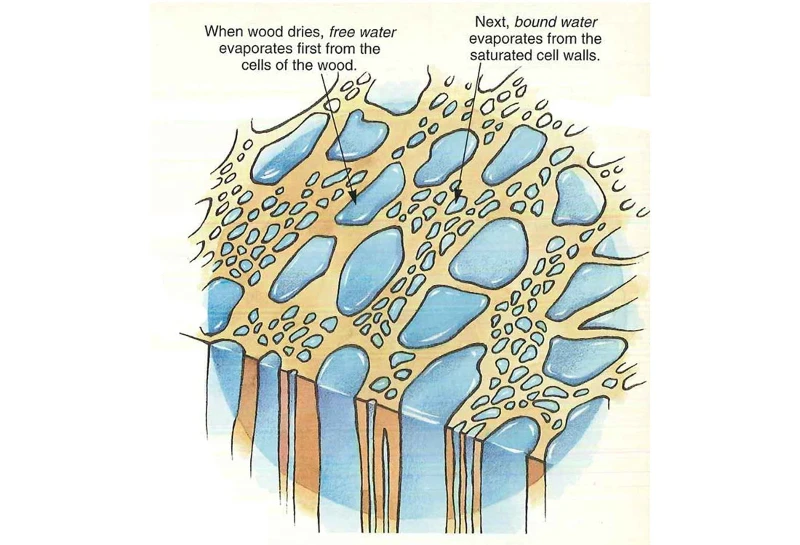
Water occurs in wood in two places. First, there's the free water that fills the inside of the wood's cells. That's like water in a bucket.
Second, water also infiltrates the cell walls. That's called bound water. Imagine squeezing a piece of cotton cheesecloth until all the free water has drained away. The cloth, through, remains damp because the material continues to contain moisture-the bound water.
When wood only contains bound water, it's said to be at its fiber saturation point. And the bound water can be eliminated completely (0% moisture content) only by drying it somewhere with no relative humidity, such as in an air-tight oven.
Wood rates as a hygroscopic substance. That is, it has an affinity for water and readily absorbs it as liquid and vapor. This ability directly depends on the humidity of the surrounding atmosphere. Therefore, the amount of moisture in wood changes as the humidity changes.
The total amount of water in any given piece of wood is called its moisture content (MC). And technically, it's expressed as a percentage of the oven-dry weight of the wood. A piece of green wood is weighed, then dried, then weighed again. Suppose the wood weighed 40 pounds when green and only 30 pounds after drying. The 10 pounds of water lost represents one-third of its oven-dry weight, so the wood would have had a 331⁄3 percent moisture content. If the piece of wood had weighed 80 pounds when green, the 50 pounds of water lost would have reflected a moisture content of 167 percent. The heartwood of black cottonwood, for instance, frequently has a moisture content of 162 percent, and ax blows produce sprays of water!
Why dry wood and finish it?
In a tree, a liquid called sap (primarily water) carries dissolved minerals and food that's manufactured by the leaves throughout the tree. Green wood refers to boards sawn from logs that had much of the original sap still in them. But it can describe rewetted wood as well. Dry or seasoned wood has had most of the sap removed.
Generally, there's a higher moisture content in the sapwood than in the heartwood of softwoods. That's because the sapwood is "living" wood that carries nutrients. In hardwoods, the difference between sapwood and heartwood varies with the species. And due to growing conditions-a north slope, river bottom, etc.-moisture content can vary from tree to tree. Moisture in the cell structure of wood makes it weaker than wood without water. Of course, it's impossible to keep moisture completely out of wood-finishes only serve to slow its movement and the reaction of the wood.
Wood exposed to an atmosphere containing constant humidity will, in time, reach a steady moisture-content condition-it doesn't gain or lose moisture. The numerical value of this stabile moisture content (MC) is called the equilibrium moisture content (EMC) of the wood, and is dependent on the relative humidity and air temperature. Over much of the United States, the outside conditions average 65 percent relative humidity, which is 12 percent EMC. Therefore, wood under cover, yet exposed to outside conditions winter and summer, will reach a 12 percent MC.
On the other hand, wood stored inside heated buildings in mid-winter can reach an MC that ranges from 4-8 percent. If you know the atmospheric conditions, you can estimate the wood's moisture content with a chart like the one below. Remember, though, that changes in wood's MC are a function of time, too, with rapid fluctuations on the wood's surface at first and very slow changes inside.