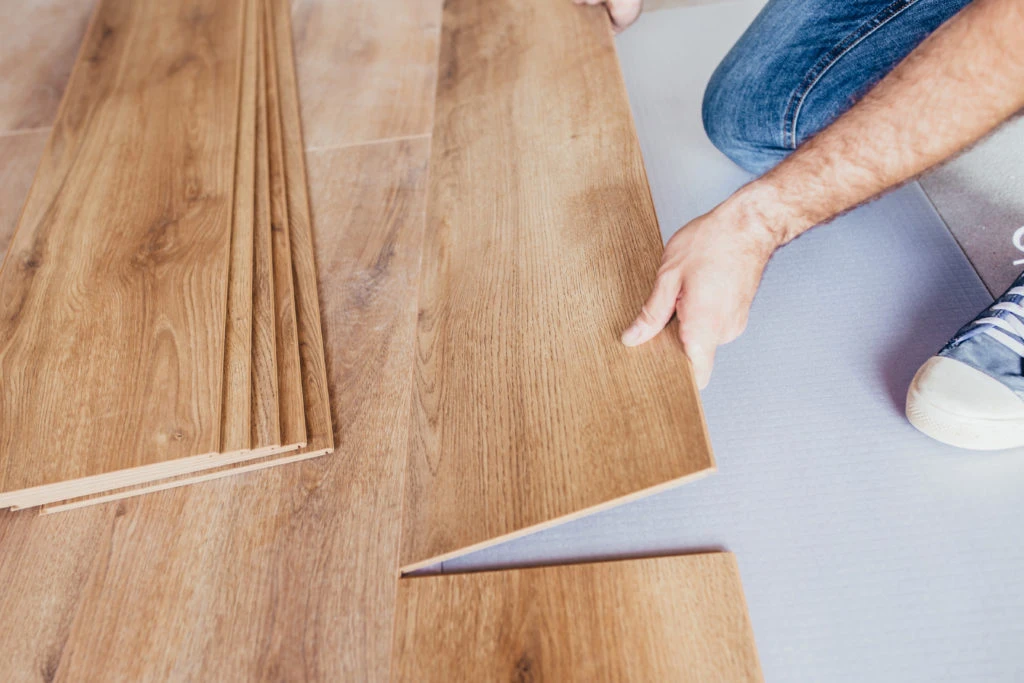
First and foremost, the term “floating floor” refers to an installation style rather than a specific product. In other words, almost any type of flooring material can be installed as a floating floor, with a few exceptions.
Now, you might be inclined to think that floating floors literally float. But as cool as that would be, floating floors simply rest atop your subflooring. There’s no need to nail or glue them down.
How Are Floating Floors Held in Place?
You can glue floating floors down. But most of the time, they’re held down by the all-powerful forces of friction and gravity.
Basically, to understand what a floating floor is, you need to understand click-together flooring. Click-together or “snap-lock” floor planks are attached to each other via tightly-fitting interlocking grooves or rivets. Think of them like a high-tech jigsaw puzzle.
When an entire floor of click-together planks is snapped together, the weight of the resulting surface—plus the friction of the connections—keeps the floor in place.
And voila! It “floats” above the subfloor.
This makes floating floors some of the easiest floors to install because you can simply snap them together.
And of course, if you do happen to make a mistake, there’s no need to rip out nails or staples in frustration. Just unsnap them and try again!
Floating Floors vs. Non-Floating Floors: What Are the Differences?
Since many types of flooring come in both floating and non-floating varieties, the only big difference is how they’re installed.
Nail-down floors are (gasp!) nailed to a subfloor or underlayment. And while that might give them some advantages, they are harder to install and remove.
- Staple-down floors are put in similarly, but are usually reserved for lighter floors like vinyl or soft(er) hardwoods.
- Glue-down floors use adhesives (sometimes containing harmful chemicals) to attach the floor to the subflooring.
So to recap: what is a floating floor? It’s a style of floor installation that doesn’t rely on a fastener (glue, nails, etc.) to attach it to the subfloor. Only gravity and friction!
What Types of Flooring Can Be Installed As Floating Floors?
Most types of flooring can be installed as floating floors. Again, “floating floor” simply refers to the installation style.
For example, many types of wood flooring can be installed as this way, though it’s important to note that the majority of these options are engineered. (Remember that!)
Alternatively, laminate, luxury vinyl plank, and even tile are available as floating floors as well.
Engineered Hardwood
Engineered wood is real hardwood. The only difference is that while solid wood is made of one solid plank throughout, engineered wood is made of a thin veneer of solid wood bonded to a super-strong plywood core. That’s about all there is to it!
Are there some engineered wood disadvantages? Sure, but none of them relate to installation. Plus, engineered wood has many other advantages over solid.
And one of those advantages is that the cost to install engineered hardwood floors is generally cheaper than the cost to install solid wood floors. That’s because a huge number of the best engineered wood flooring products can be installed as floating floors. And floating floors are cheaper to install in general!
Laminate
If you love the idea of fake wood flooring, laminate can almost always be installed as a floating floor.
What is laminate flooring? It’s a composite floor that’s often made of three layers. From the bottom, they are:
A core layer, usually made of fiberboard or plywood, which gives the flooring its base.
- A design layer that offers a photorealistic image of whatever the floor is imitating (like real wood or stone).
- And a wear layer that acts as a shield for the underlying layers.
There are even waterproof laminate options these days like Mohawk’s RevWood, which relies on its click-together fasteners to create a watertight seal. And if you’re nervous about the phrase “composite floor”, don’t be—non-toxic laminate flooring is relatively common!
Luxury Vinyl Plank
Luxury vinyl plank, or LVP, is another good floating option. In fact, almost all LVP products can be floated. (Quick note: “LVT” or “luxury vinyl tile” is essentially the same thing as LVP).
If you look into the differences between vinyl plank vs. laminate, you’ll find that they have a similar design structure. LVP is just composed primarily of vinyl instead of multiple materials.
This makes LVP a better option for hard-wearing applications like mudroom flooring because it tends to be a little more robust. And while there are some vinyl plank flooring disadvantages, it is almost always waterproof—thanks, in no small part, to its click-together floating installation!
If LVP sounds like a good fit for you, check out some Pergo Extreme reviews—Pergo Extreme is one of the most popular vinyl plank options on the market.
Tile
Tile is one of the oldest types of flooring in the world. And perhaps as a result, there are tons of types of floor tiles to choose from.
Unfortunately, tile is also one of the hardest (and most expensive) types of flooring to install. In fact, a shortage of qualified tile installers is one of the biggest issues facing the flooring industry today.
To address this, tile manufacturers have created a solution: snap-together tile flooring. That’s right—you can now install floating floors made of real porcelain tile!
Previously, buyers comparing tile vs. laminate often went with the latter because tile is so expensive to install. But not anymore!
Snap-together tiles are a great option for bathrooms and kitchens, or anywhere spills might be common. They’re easy to install and come in a variety of colors and designs. Wood-look tile, for instance, is a great alternative to hardwood flooring for areas that are prone to moisture.
Carpet Tiles (Sort Of)
Okay, we might be bending the definition of what qualifies as a floating floor here, but peel-and-stick carpet tiles basically act like a floating floor system. You don’t have to staple them down, and while there is a “gluing element”, they’re still easy to remove and DIY friendly.
So, you could say carpet tiles capture the spirit of floating floors—after all, what is a floating floor if not a cheaper and easier installation method?
Anyway, carpet’s best perk is that it’s probably the comfiest flooring you can get. In the debate between carpet or hardwood in the bedroom, many people continue to choose carpet solely because it won’t freeze their feet off in winter.
Carpet similarly wins the carpet vs. laminate when it comes to comfort. And rest easy, earth warriors—there are numerous low-VOC carpet choices available for people who are sensitive to chemicals!