
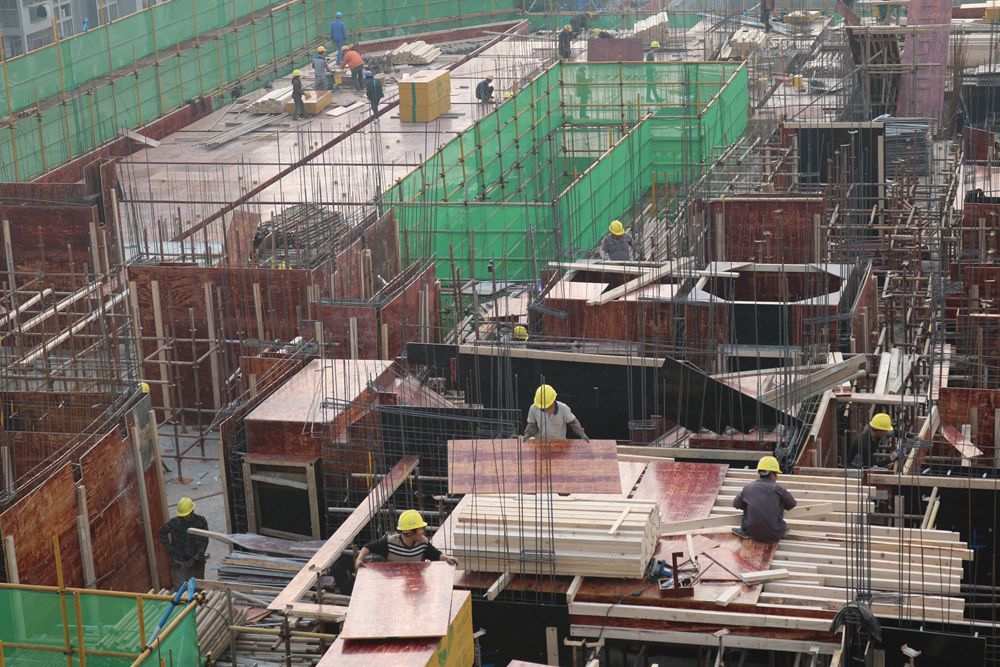
Plywood is a board made by rotating and cutting logs into large veneers in the direction of annual rings, and after drying and gluing, the billets are assembled and glued according to the principle that the wood grain directions of adjacent veneer layers are perpendicular to each other. The number of veneer layers is odd, generally from three to thirteen layers. Common ones include plywood, plywood, ninth plywood, and thirteen plywood (commonly known on the market as three-plywood, five-plywood, nine-plywood, and thirteen-plywood). board). The outermost front veneer is called the front panel, the back is called the backplane, and the inner layer is called the core board. Plywood can improve the utilization rate of wood and is a major way to save wood.
Use of Plywood in Construction Engineering
The most prominent use of plywood is in structural applications. Plywood can naturally withstand a lot of stress and full weather exposure. Structural plywood is best used for beams and hoardings, but it is commonly used in crates, bins, internal structures, outdoor furniture, and boxes. Structural plywood is used for wall and roof bracing.
There are several plywood grades in the market, the most common and popular being A-grade which can take some serious beating. It is not uncommon for highly durable boards to withstand continuous boiling without delaminating. However, there is marine plywood which is made with glues that are completely weatherproof and boilproof.
It is also common to use B-bond grade structural plywood. This obviously comes at the cost of durability, but the material is sturdy enough for use in exterior door skins and concrete formwork.
There’s also C-grade plywood, which is un-sanded and likely to have several minor defects that will need to be repaired. C-plywood is used in cases where appearance and durability aren’t that important, such as subfloors and garages. At the very low-end of the spectrum is D-grade plywood, which is un-sanded and guaranteed to have defects that haven’t been repaired. D-grade plywood is identifiable by obvious discoloration and sanding defects.
It is common for manufacturers to pair up different grades of plywood to save on costs. The most popular example is BC-grade, which is a mix of B-grade plywood on one side and C-grade on the other side.
i) Exterior Plywood
As the name suggests, exterior plywood is used outside the house in items that require some serious durability. This type of plywood is bound together using water-resistant glue that doesn’t wear off easily. Some of the most suitable applications for exterior plywood are walls, roof linings, stables, and even outdoor floorings.
ii) Interior Plywood
In this type of construction, aesthetics and appearance take priority. This is because the foundation of the walls and roofs are already laid out, requiring minor aesthetic touch-ups. Interior plywood is not very resistant against outdoor elements and tends to degrade quickly when exposed to moisture and heat.
Some of the popular applications for interior plywood include indoor furniture, interior cladding, and ceilings.