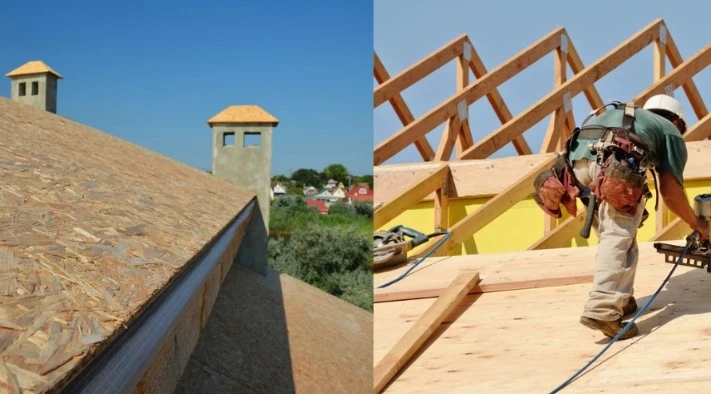
Is OSB better than plywood for roofing?
As we explained above, plywood consists of multiple layers of wood called veneers. These are arranged in alternating grain and glued on top of each other with a hot press.
Finished plywood sheets always feature an odd number of veneers, so cross-lamination techniques are balanced.
As for OSB (oriented strand board), it’s manufactured by adhering together small pieces of wood then compressing them. OSB panels are available in lengths up to 16 feet, and you can easily identify them by observing their distinct wood strands.
The following is a simple breakdown of plywood vs. OBS for roofing:
Price — OBS is less expensive compared to plywood.
Available sizes — OBS is sold in larger panels up to 16 feet long, whereas plywood panels come in a maximum length of 8 or 10 feet.
Water test — most types of plywood have good resistance against moisture. OSB plywood, on the other hand, easily absorbs water when exposed to moisture. A 1/2 inch OSB panel can swell up an additional 1/4 of an inch overnight.
Formaldehyde — OSB has a higher concentration of formaldehyde compared to plywood. Formaldehyde has been associated with occupational asthma.
Market share — OSB accounts for about 70 to 75 percent of the market share, while plywood makes up around 25 percent.
Wood constituents — OBS comprises 95 percent wood and 5 percent wax and resin, while plywood is 100 percent solid wood veneers.
Grades — OBS is available in several grades, including OSB/1, OSB/2, OSB/3, and OSB/4. As for plywood, it comes in 4 primary grades of plywood veneer, which are A, B, C, and D.
Strength — OSB is more fragile than plywood panels, which possess less sheer strength when it comes to strength.
Plywood for Roof Sheathing
Roof sheathing or roof decking involves installing a layer of plywood or OSB to cover the joists and trusses, the beams that make up the skeleton structure of a roof.
The sheathing is placed below the roof’s shingles and above its framework. It provides the roofing tiles and shingles with a support layer to rest on.
The purpose of sheathing is to:
Provide support as it prevents the direct attachment of shingles to joists and trusses by evenly distributing their weight shingles.
Provide extra protection by incorporating an additional layer of insulation to resist leaks and reduce the spread of fires.
Roof sheathing is typically made out of wood, either plywood or OSB. While the latter is less expensive, it’s more fragile and lightweight, so many roofers go for plywood.