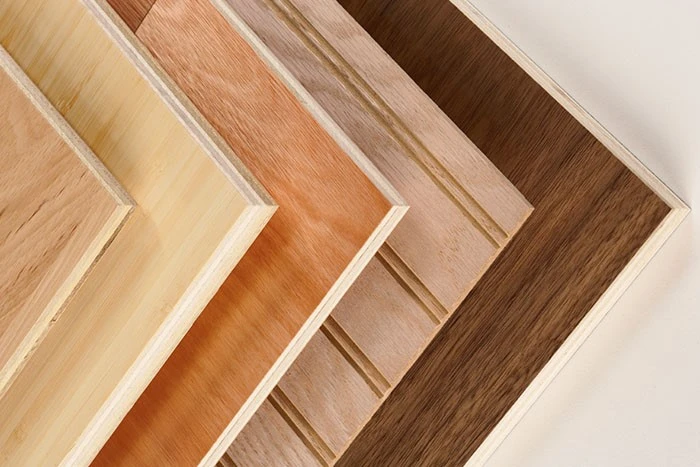
There are a lot of types of ply, practically, for any purpose and task. It will not be possible to consider everything in detail in one article, we will list only the main ones.
Coniferous plywood
One of the most common species around the world. Used primarily in construction and industry.
Hardwood plywood
Such ply has a high hardness and strength in comparison with softwood, softer and more viscous. It is highly resistant to damage and wear and tear, and is suitable for the harshest conditions, including flooring and walls.
Tropical plywood
It is made from tropical timber from Asia, Africa, South America. It is distinguished by its high viscosity, combined with the strength and uniformity of the layers.
Due to these characteristics, tropical plywood is used abroad in construction, industry, furniture production, and design.
Tropical ply looks very attractive even without additional processing.
Aviation plywood
This high strength plywood is made from mahogany or birch, or a combination of both, and glued with heat and moisture resistant glue.
During World War II, aviation plywood was used in aircraft construction, and nowadays it is used where strength and resistance to overloads are needed.
Decorative plywood
Hardwood is used for its production, and the scope of application of finished sheets is furniture, wall panels, various design projects.
It is additionally covered with resin-impregnated plastic or paper veneer.
Marine plywood
It is a good choice for the manufacture of boats and any items in contact with moisture and water.
Marine plywood is highly resistant to fungus, delamination and deformation under the influence of moisture.
The main disadvantage of such ply is its high cost. It is much more expensive than other varieties.
Laminated plywood
The sheet is covered with a hot laminate. Such material is used for formwork, for example, concrete structures, holding brick arches and other forms using a liquid plastic solution before it solidifies.
Film faced plywood
Film faced ply is also used for decorative purposes, as well as where a non-slip surface is needed.