

What is plywood?
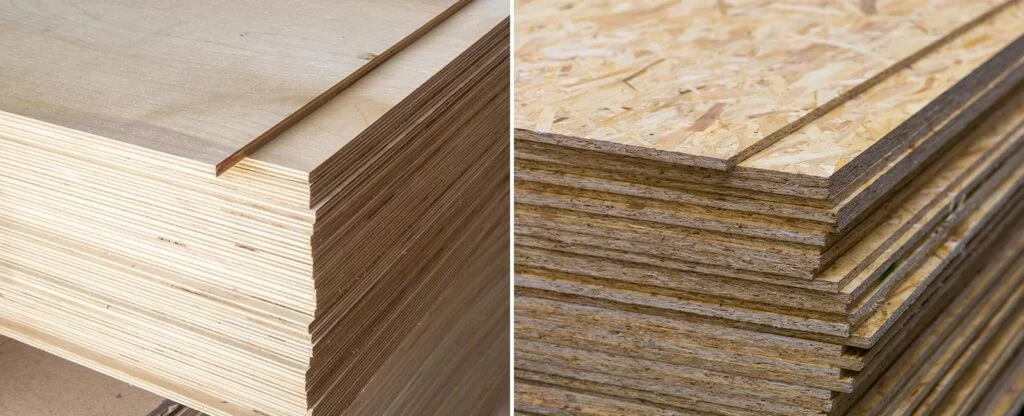
Plywood is an engineered wood made from several layers of wood veneers. Each layer is called a ply, hence the material’s name.
To make plywood, adjacent plies are glued together with their grains at a 90-degree angle to each other. This helps to strengthen it and prevent it from shrinking or swelling.
Manufacturers use different kinds of wood depending on what is locally available to them. In Australia, most companies use eucalyptus, fir, pine, ash, beech or birch. Some plywood makers also use mahogany, maple, oak or teak.
You can choose from a variety of plywood types. Each one has unique characteristics that make it more suitable for specific applications.
Because plywood is made from wood veneers, each ply may have knots and other unique peculiarities that create slight variations in its depth and thickness. Thus, plywood’s structure is typically not uniform throughout.
Structural plywood
Interior plywood
Exterior plywood
Cladding plywood
Bamboo plywood
Marine plywood
Find out more about the benefits of using plywood here.
What is OSB?
OSB, which stands for oriented strand board, is likewise an engineered wood composite. However, it is more similar to particleboard than plywood.
To make OSB, manufacturers use wood from trees such as aspen, southern yellow pine, poplar, or black poplar. They break down the logs to turn them into wood strands, known as flakes. They then dry the strands using high heat.
Once dry, the wood flakes are blended with a mixture of resins and waxes to improve the board’s moisture resistance. Manufacturers then layer the strands on a mat and press them using a machine. They then air out the boards to remove harmful fumes before cutting them to size.
In some cases, OSBs may be modified to serve a particular purpose. Radiant barrier is one such modification that involves adding low emitting aluminum foil to one side for insulation’s sake. Meanwhile, OSBs with tongue-and-groove cuts are designed to interlock to one another for easier attachment.
Just like plywood, OSB comes in several types as well. They represent the board’s different grades, depending on its mechanical performance and resistance to moisture.
OSB/0 (Does not contain formaldehyde)
OSB/1 (General-purpose board used in dry conditions)
OSB/2 (Load-bearing board used in dry conditions)
OSB/3 (Load-bearing boards used in humid conditions)
OSB/4 (Heavy-duty, load-bearing boards used in humid conditions)
Why should you use plywood subfloor?
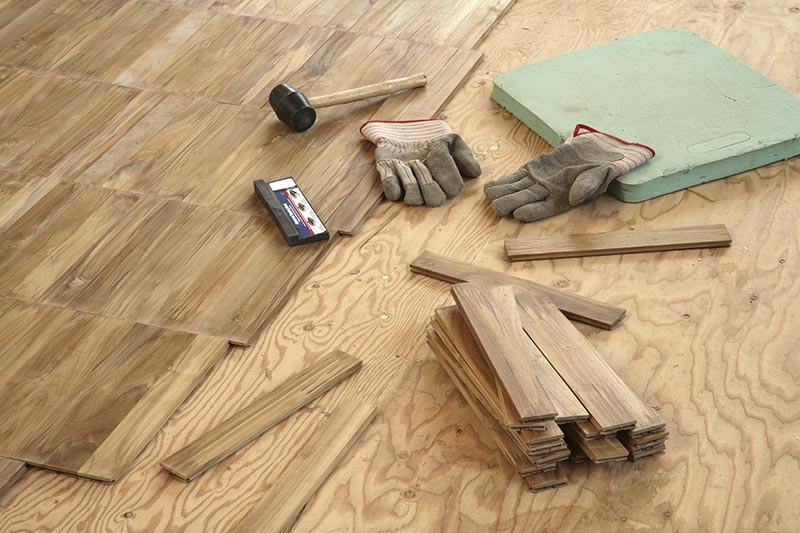
Many builders use plywood because of its durability and flexibility. Unlike solid wood, plywood boasts of uniform strength along grains regardless of direction. You can use it for different purposes without worrying about its structural integrity.
Plywood also has excellent pliability. Even if you bend it in different ways, it won’t split or break easily. This, along with its lightweight construction, makes it ideal for building various shapes and forms.
Plywood also looks great. Even if it’s engineered wood, ply still retains much of the natural beauty of timber. You can also paint or stain plywood to help improve its visual appeal.
And finally, plywood’s definitive edge over OSB is how it behaves when it gets wet. Plywood swells consistently all throughout when exposed to moisture. But then it dries out quickly and returns to its original dimensions.
Plywood Pros
Comes in different sizes
Not prone to swelling or warping due to moisture
More aesthetically pleasing; can be stained or painted
Suitable subfloor for all flooring materials
Plywood Cons
More expensive than OSB
Not as environmentally friendly (may contain formaldehyde)
Available panels are not as large as OSB
Structure is not uniform
Why should you use OSB subfloor?
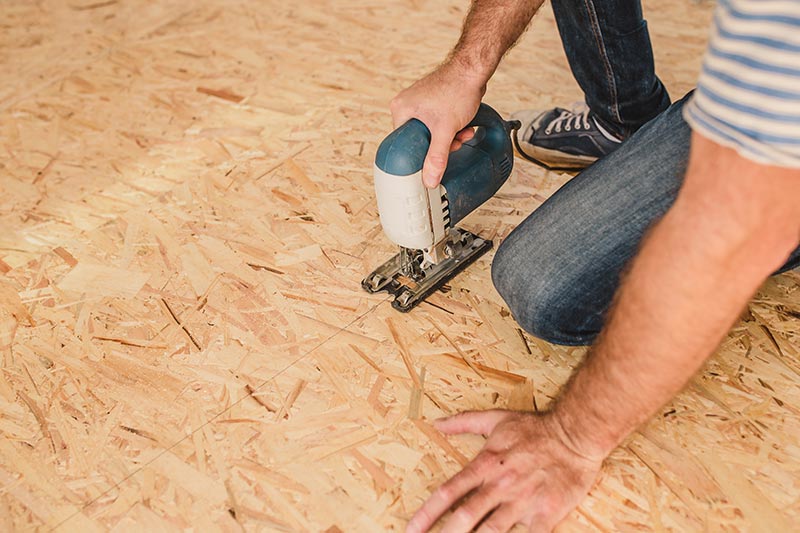
OSB is deemed to be more environment-friendly and sustainable because it is made of small, fast-growing trees.
OSB provides several benefits to builders as well. For one, it’s a lot more affordable compared to other subfloor materials. This can help lower your construction costs significantly without sacrificing strength and durability too much.
Most manufacturers also offer customisation for their OSB products. You can order tailor-made boards to suit your design and other building needs.
Oriented strand boards are generally water resistant. In fact, it takes longer for water to seep into OSB than plywood. However, OSB also takes longer to dry out. Furthermore, OSB’s edges are also prone to irreversible swelling.
Because of this irreversible expansion along the edges, experts caution against using OSB as a subfloor for certain flooring, particularly ceramic and vinyl tiles.
OSB Pros
More affordable than plywood
Available in larger panels
Made from fast-growing trees
Denser and heavier than plywood
More structurally consistent than plywood
OSB Cons
Swells when exposed to water
No finished appearance
Cannot be painted
May contain formaldehyde
Not a suitable subfloor for ceramic and vinyl tiles

