


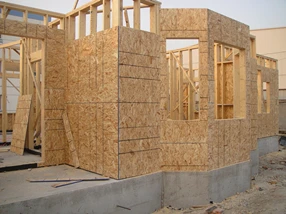
The first thing you need to know is what an OSB board actually is. Many people are confused about this, thinking that it has something to do with the outside of a house or building. It does not. The ‘OS’ in OSB stands for Oriented Strand Board and the material was created by the Boise Cascade company.
The material is a type of engineered wood and has been used very often in flooring, wall sheathing, roof decking and other projects where strength is needed to hold up under high loads or weight.
How to Keep OSB Board
Schedule timely deliveries.
Contractors and builders can work with their Spahn & Rose sales representatives to help make sure OSB deliveries are timed precisely to when you’ll need the material. Given recent supply-chain difficulties, your Spahn & Rose sales representative can provide ongoing updates about delivery times to make planning easier. “Leaving OSB outside for short periods of time, a week or so, is OK,” Reiff says. “But any longer, and in damp conditions, moisture will be absorbed and the edges will swell.”
Place OSB in a flat orientation.
Whether moving OSB or storing it at a job site, keep the panels in a flat orientation. Also, when you’re moving individual panels during the building process, keep them flat as well—this will help prevent the edges from getting dinged. When moving stacks of OSB with a forklift, use a pallet and insert the forklift tines between the supports, not into or directly on the stack.
Keep OSB off the ground.
“Air movement around a stack of OSB will allow the building material to dry out and not collect moisture,” Reiff says. One of the easiest ways to keep the wood off the ground is to place the stack on four-by-fours. One four-by-four should be in the center of the stack, with two others about a foot from each end. Look for an area of dry ground with no puddles underneath where you plan to store the OSB on the job site.
Cover OSB if it’s not being used.
During construction, as long as there’s no rain, OSB can remain uncovered. This makes it easier to access. However, if there’s rain in the forecast—or if the OSB will sit unused for more than a week—Reiff advises that you cover it with a tarp.

